«Whoever does not renounce all his possessions cannot be my disciple.»
Jesus is on his way to Jerusalem, where he will be judged, put to death, buried, and finally rise again. Along his journey, he encounters various realities and, as he goes, he accompanies the people with his teachings. In the preceding verses, it is told that those invited make excuses not to attend the banquet, but the feast is already prepared; the servants are sent out to invite those on the roads, in the streets and squares, to fill the house, because the gratuity, the hour, the kairos of the Kingdom of God cannot wait.
Last Sunday we read that Jesus explained why one should not seek the first places, and he exhorted: «When you give a banquet, invite the poor and the crippled… and you will be blessed, because they cannot repay you; you will be repaid at the resurrection of the just.»
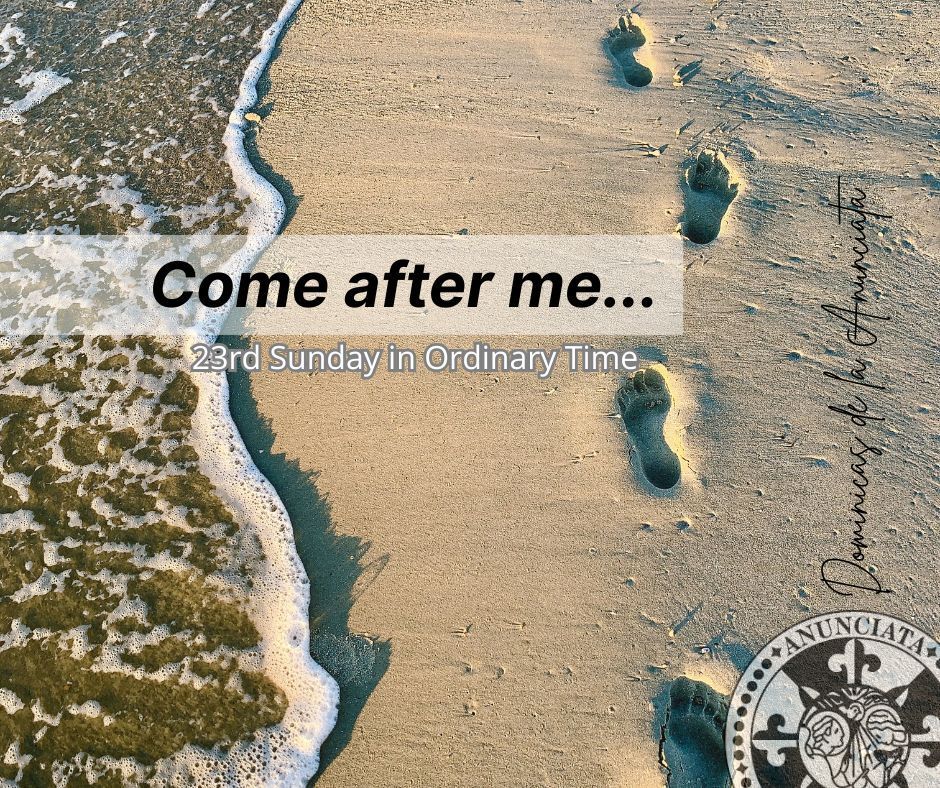
In today’s Gospel, the 23rd Sunday in Ordinary Time, Jesus continues moving, journeying with many people. Looking at them, he says (v. 26): «If anyone comes to me and does not hate his father, mother… even his own life, he cannot be my disciple.» Jesus demands in discipleship a total surrender (understood as detachment that brings freedom): love for Him and for the Kingdom must come above all other loves, even to the point of self-denial and overcoming all selfishness. That is, in ongoing conversion, in the process of becoming, of building oneself as a disciple, together with the brothers and sisters, in community, together as Church.
In v. 27, he invites us to carry our own cross and follow the Master as the condition of discipleship, recognizing that He first carried the cross of all humanity, and therefore our cross. For us, the cross means faithfulness to the Gospel in daily life, when the difficulties of life weigh heavily, yet trusting in the One who loved us first. And renewing surrender, love, beyond circumstances, sustained by His love, His goodness and mercy.
Verses 28–32 present examples of people who reflect before beginning a project. We must do the same: discipleship is not a naïve following, but an active, trusting, serious, and responsible one, requiring constant and courageous reflection—especially when following Christ, in certain circumstances, may demand giving one’s life (martyrdom). In other, more common cases, following Jesus is a continuous commitment that lasts a lifetime: we give our lives daily, not only as renunciation but as a gift of love for others, leading us into a lasting life with Him.
Finally, in v. 33, he declares that the disciple must renounce all his possessions in order to follow Him, so that the heart belongs to God alone. The Lord asks for an undivided heart, free from attachments, in order to love, serve, and share.
We may ask ourselves: what place does Jesus have in my life? Am I willing to make Him the center of my life, even if that means renunciations and misunderstandings?
Let us not be discouraged: to follow Christ in faithfulness is grace and gift. Jesus shapes the disciple into a radical love that opens us to true freedom.
Sr. Fanny Calderón Pérez
Province of Saint Rose of Lima