Three words on the Passion according to St. Luke: forgiveness, today and spirit.
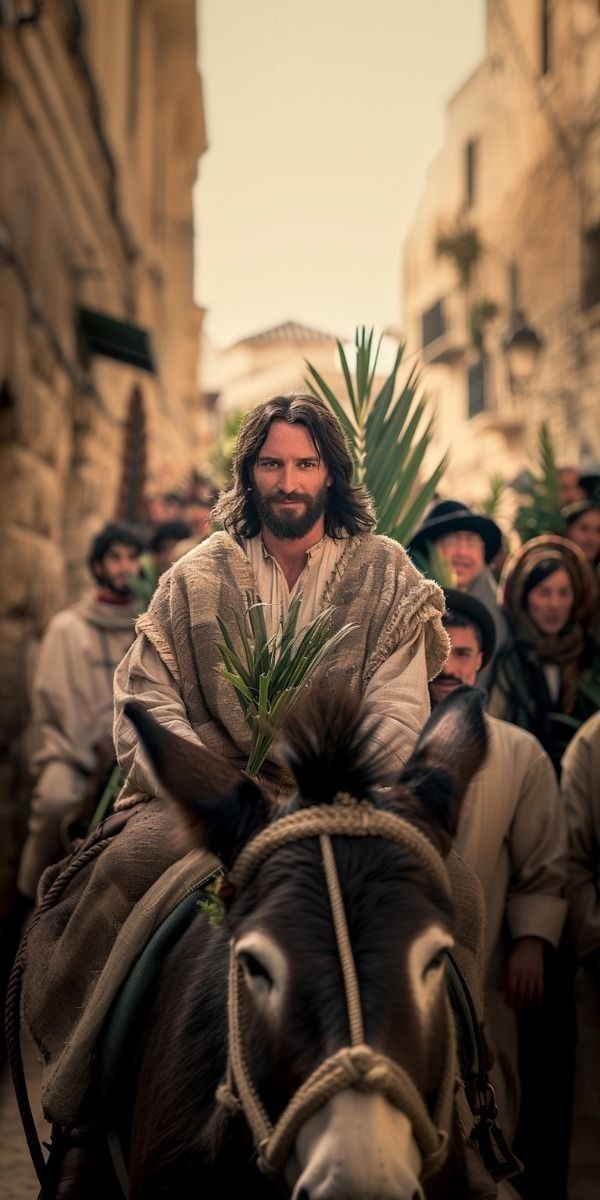
Palm Sunday solemnly opens Holy Week, with the remembrance of the Palms and the Passion, of Jesus’ entry into Jerusalem and the liturgy of the word that evokes the Passion of the Lord in the Gospel of St. Matthew.
It was the proclamation of the love of a God who descends with us to the abyss of meaninglessness, of sin and death, of the absurd cry of Jesus in his abandonment and extreme trust. It was a proclamation to the pagan world, all the more realistic in that it could be used to measure the power of the Resurrection.
The procession is above all a joyful witness that we offer to Jesus Christ, through whom the Face of God has been made visible to us, and through whom the heart of God is opened to all of us. In Luke’s Gospel, the narrative of the beginning of the procession in the environs of Jerusalem is composed on the model of the coronation rite with which, according to the First Book of Kings, Solomon was declared heir to the kingship of David (cf. 1 Kings 1:33-35). Thus, the procession of the Palms is also a procession of Christ the King: we profess the kingship of Jesus Christ, we recognize Jesus as the Son of David, the true Solomon, the King of peace and justice. To recognize him as King means to accept him as the One who shows us the way, the One we trust and follow. It means to accept day after day his word as a valid criterion for our life. It means seeing in Him the authority to which we submit ourselves. We submit to him because his authority is the authority of truth.
Above all, the procession of the Palms is, as it was on that occasion for the disciples, a manifestation of joy, because we can know Jesus, because he allows us to be his friends and because he has given us the key to life. This joy, which is at the origin, is also an expression of our “yes” to Jesus and of our readiness to walk with him wherever he leads us. The exhortation at the beginning of our liturgy rightly interprets the meaning of the procession, which is also a symbolic representation of what we call “following Christ”: “Let us ask for the grace to follow him,” we have said. The expression “following Christ” is a description of the whole Christian existence in general. What does it consist of? What does “following Christ” mean in concrete terms?
Sister Mercedes Rax Cucul
Friar Martin de Porres Community, El Salvador
Province of St. Martin de Porres