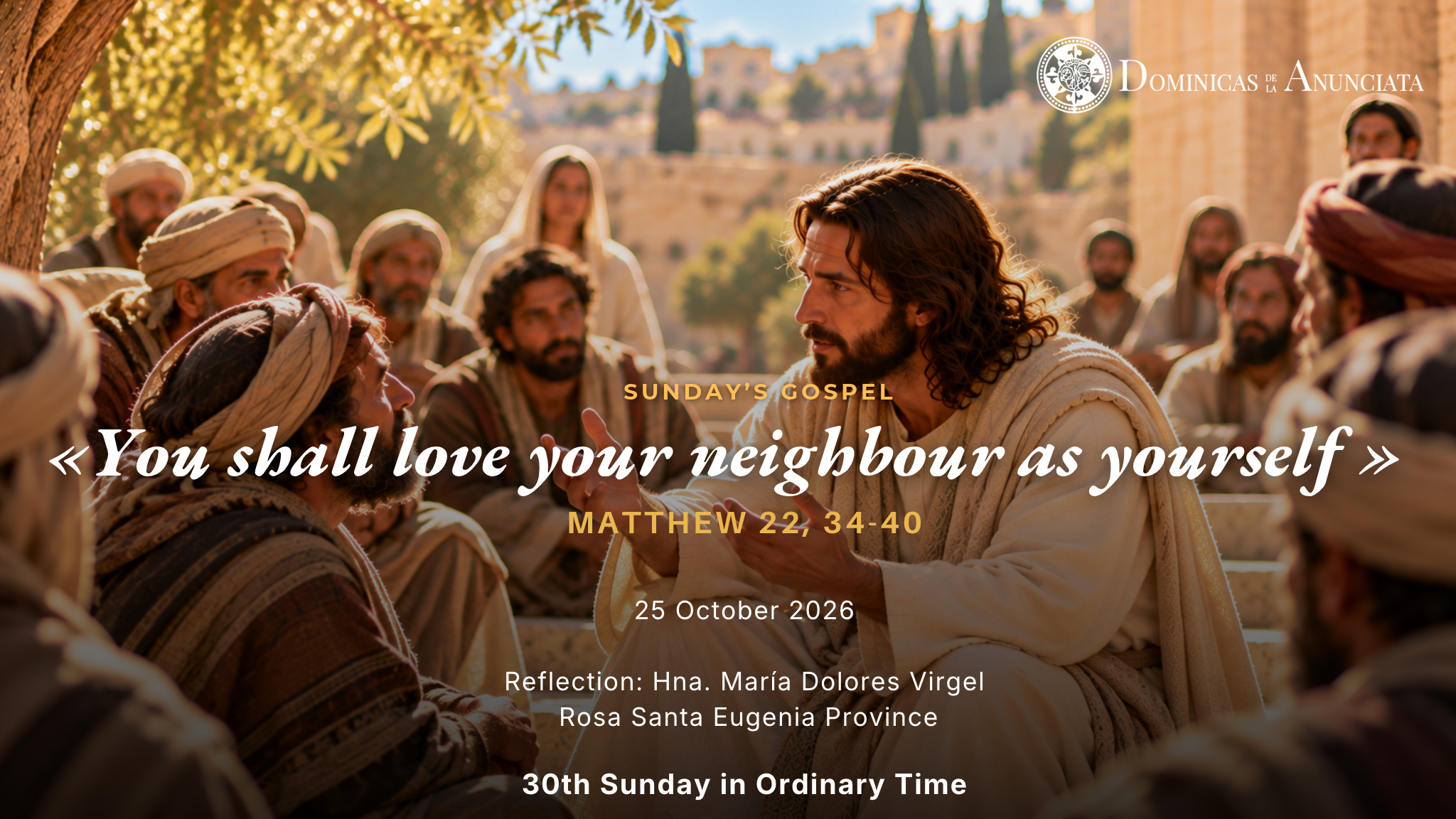
“You shall love your neighbor as yourself”
Mt.22,34-40
We have now reached the final stretch of the liturgical year, the Thirtieth Sunday in Ordinary Time. The weeks are passing, and the Church is gradually leading us towards the culmination of the year, a time of spiritual maturity in which we are invited to take stock and discern what is truly important in our following of the Lord. At this stage of the journey, the Gospel is bringing Jesus’ teaching in Jerusalem to a close. Last Sunday, we heard how they tried to trap him with the question about the coin used to pay the tax to Caesar, reminding us of the need to “give to God what belongs to God”—that is, our very lives, which bear his image. Next Sunday, the Lord will warn us against inconsistency and outward appearances, criticising those who judge what others do but do not lift a finger themselves.
Today’s Word is placed precisely between these two warnings. Looking back, we can ask ourselves: Have we placed love at the centre of our daily routine and prayer, or have we sometimes worn ourselves out with secondary concerns, organisational tasks or simply fulfilling our obligations?
The Master does not get lost in arguments; he points us towards the cornerstone of our entire Christian and consecrated life: Love. Yet we know well that love has its own personal journey and process of maturation. We no longer love as we did when we were young. The impulses of our early years, full of enthusiasm, projects to accomplish and the need for outward expressions of affection, have gradually given way to a different kind of love: a love that focuses on what is essential, no longer needing lengthy explanations or making a great deal of noise, but measured by persevering fidelity, a peaceful presence and a mature acceptance of life and of others.
The first reading, from the Book of Exodus, makes this commandment very concrete and unequivocal: God hears the cry of the foreigner, the widow, the orphan and the person burdened by debt. Loving God is absolutely inseparable from welcoming and caring for human vulnerability. In today’s Spanish society—often fast-paced and divided, where so many people are suffering—the Gospel does not ask us to achieve great things beyond our reach, but to offer the tenderness of those who have learned to love through small, everyday gestures. Thank you, Lord, for the growth in LOVE that you have brought about in us!
As we look at the daily life of our communities, we must ask ourselves: How do we live out this mature love today? Do we recognise the face of God in the sister with whom we share a home, patiently accepting the limitations that come with age, illness or the wear and tear of life’s journey? In our daily life together, the principal commandment is expressed today in our ability to accompany others in silence, to forgive, to give thanks and simply to remain by one another’s side. At the same time, with the perspective that the passing years give us, does our heart still beat in tune with the “strangers” and vulnerable people in our society? Is our humble and faithful prayer a constant channel of intercession for the sufferings of our world, or are we sometimes tempted to withdraw into a self-centred kind of seclusion?
The commandment also reminds us to love our neighbour “as ourselves”. In this personal journey towards mature love, are we able to accept peacefully our own diminishing strength, to love our present vulnerability and to allow ourselves to be cared for with humility and gratitude?
Saint Paul praised the Thessalonians because, amid many struggles, they preserved the joy of the Holy Spirit, and their faith resounded everywhere. At this stage of the liturgical year, even if our physical strength is no longer what it once was, our mature and dedicated communities continue to offer a precious testimony: that of a love that has stood the test of time and has become pure and transparent.
Thank you, Lord, for the peace and joy you give us as we renew our YES to you. Help us to love you with all our hearts and to make your LOVE visible through each sister’s fidelity and through our daily self-giving.
Sister María Dolores Virgel
Rosa Santa Eugenia Province